




- 15 Jun
- 2026
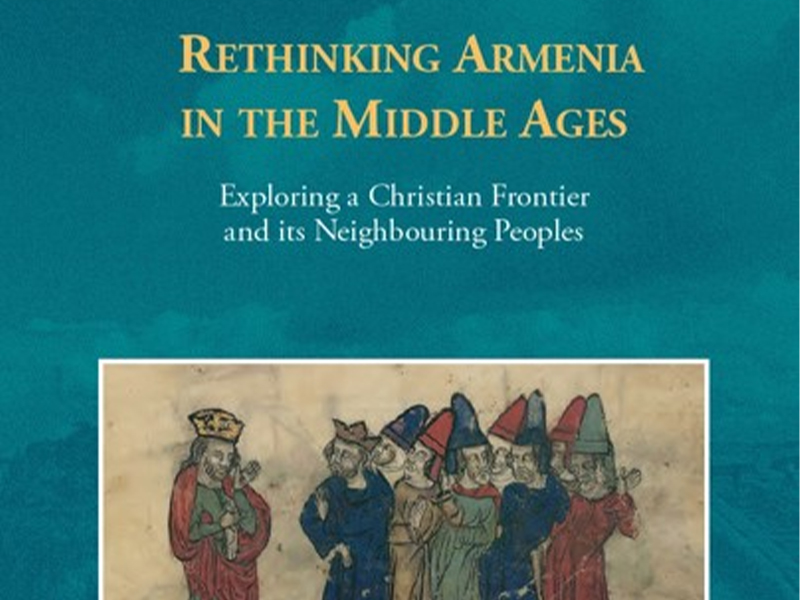
Collective Monograph Rethinking Armenia in the Middle Ages Published by Brepols
The volume is edited by Professor Yervand Margaryan, Director of the Institute of International Relations and Socio-Political Science at the Russian-Armenian University, and Lusine Margaryan, Lecturer at University College Cork (Ireland).
Brepols Publishers, one of the world's leading academic publishers in the humanities, specializing in medieval studies, history, archaeology, and critical editions of historical sources, has published the collective monograph Rethinking Armenia in the Middle Ages: Exploring a Christian Frontier and its Neighbouring Peoples (Borders, Boundaries, Landscapes series, vol. 6).
The volume is edited by Professor Yervand Margaryan, Director of the Institute of International Relations and Socio-Political Science at the Russian-Armenian University, and Lusine Margaryan, Lecturer at University College Cork (Ireland) and participant in the Marie Skłodowska-Curie project Christian Frontiers.
The book reconsiders Armenia’s place in the medieval world. During the medieval period, Armenia occupied a distinctive position at the crossroads of major empires — Byzantine, Arab, Mongol, and Persian. Rather than pursuing territorial expansion, Armenian society developed a civilizational strategy grounded in cultural resilience and intellectual creativity. Through Christianization, the invention of a unique alphabet, and extensive translation movements, Armenians fashioned themselves into a learned culture capable of mediating between competing political and cultural worlds.
The volume explores how Armenia navigated life on the borders of successive empires by deploying what may be described as soft power avant la lettre — mobilizing religious identity, literacy, and cultural production as a means of survival and influence. The collected essays examine three interconnected themes: Armenian self-understanding at the margins of empire; the ways in which imperial centres perceived and engaged with Armenian difference; and comparative perspectives on Armenia alongside other frontier societies confronting similar historical pressures.
Among the contributors are Russian-Armenian University scholars Associate Professor Beniamin Mayilyan and Anastasia Palamarchuk.
The publication is intended for historians, medievalists, cultural scholars, and all those interested in medieval Armenia and the dynamics of intercivilizational contacts across Eurasia.
Latest News
-
15 June , 2026
-
11 June , 2026
-
02 June , 2026