





.jpg)
- 01 Mar
- 2019
InScience | #1 Wolfram’s Knowledge-based Programming
Did you know that Apple’s Siri, Samsung S Voice and Amazon Alexa are powered by Wolfram technologies?
Symbolic, interactive and knowledge-based, Wolfram Language Wolfram Mathematica is a world-class software platform for high-level research in many areas. As more researchers face the need to do data analysis and computation in their work, Wolfram software opens up a whole world of possibilities for a curious mind.
Background
The mastermind behind the Wolfram language, Stephen Wolfram, Ph.D., wrote his first research paper on particle physics at the age of 15, while at 20 he was already a Ph.D. holder. Stephen Wolfram developed Wolfram Language back in the 1980s for the computational system Mathematica, but it was introduced as a separate computer language only in 2013. To this day, he is the CEO of the company Wolfram Research, Inc.
Aside from R&D, Stephen Wolfram is very much involved with the company products - he has written a guide An Elementary Introduction to the Wolfram Language, filmed a video introduction where he explains the basics himself, and he writes a blog about everything that has to do with Wolfram products.
Mathematica & Wolfram Language
Wolfram Language is at the core of all products developed by Wolfram Research, Inc.
Stephen Wolfram in his blog post describes it as a language that combines features of both human and computer language:
“Our language works in a somewhat different way from ordinary human natural language - most importantly, because it’s completely executable: as soon as we express something in the language, that immediately gives us a specification for a unique sequence of computational actions that should be taken.
And in this respect, our language is like a typical computer language. But there is a crucial difference, both practical and philosophical. Typical computer languages (like C or Java or Python) have a small collection of simple built-in operations, and then concentrate on ways to organize those operations to build up programs. But in our language - built right into the language - is a huge amount of computation capability and knowledge”.
What makes Wolfram Language different from any other computer language is the fact that it is knowledge-based, symbolic, interactive and functional.
_1645099064.jpg)
Knowledge-Based: As one of its core principles, the Wolfram Language has extensive knowledge —about algorithms and about the world - built in.
Symbolic: In the Wolfram Language, everything (code, data, images, documents, interfaces, programs, etc.) is a symbolic expression.
Interactive: Wolfram Language code can be run interactively as a document-based REPL dialog between the user and the system.
Functional: With its symbolic character, the Wolfram Language supports an extended form of functional programming based on generalized transformations.
_1645099168.jpg)
Its primary platform is Mathematica, which integrates a vast collection of algorithms, high-performance computing capabilities, as well as a powerful visualization engine in one system. The system knows a great deal about the world – it has maps, statistics, scientific and socioeconomic data ranging from birth rate in Armenia to formulas for computing a Doppler shift.
It was Apple cofounder Steve Jobs, who suggested the name of the program "Mathematica" to Stephen Wolfram.
It was Apple cofounder Steve Jobs, who suggested the name of the program "Mathematica" to Stephen Wolfram.
Known for its ability to run complex calculation, build models and prototypes, Wolfram Mathematica is a widely used tool in many areas of research. For instance, with Wolfram you can run a forecast on the currency exchange rate based on the previous data. It has applications in medicine as well – when developing a new drug, pharmaceutical companies usually conduct research, run various tests and experiments, which requires extensive financial and human recourses. Instead, they have an option to run a computational model based on the accumulated data to determine the best output via Wolfram Mathematica.
Some effects for the sci-fi movie Interstellar were first generated with the help of Wolfram technologies, as well.
For Beginners
One of the new features is the interactive guide Wolfram Programming Lab that has an accompanying programming course for those who are willing to get the knack of the language themselves.
Wolfram|Alpha
Wolfram products have room for everyday queries, as well. Wolfram has its own “Google” – Wolfram Alpha.
Unlike common search engines, Wolfram Alpha, described as an “answer engine”, does not give you web links in response to what you have typed, instead it computes an answer for your request based on the built-in data. For instance, you can try putting “biggest city in the world”, and you will get a generated encyclopedia article about Shanghai rather than millions of links on the largest urban areas.
_1645099335.jpg)
If you want to compare the amount of sugar in 1 litre of orange juice to 1 litre of carbonated beverage, you simply put “sugar in 1 l. orange juice, 1 l. sprite”, and the engine will compute the comparison for you. You can alter the type of juice later by choosing fresh, canned, etc.
Its built-in data covers vast areas in Mathematics, Statistics and Data Analysis, Engineering, Earth Science, Computational Sciences, Units and Measures, Dates and Times, Weather, Places and Geography, People and History, Words and Linguistics, Sports and Games, Money and Finance, Socioeconomic Data, Health and Medicine, Organizations, etc.
Wolfram For Education
Wolfram Research, Inc. continues to encourage students at schools and universities to learn programming and skills related to STEM by implementing Wolfram products in their studies - for homework, projects and learning outside the classroom.
 Given the automotive character of the language, Wolfram Alpha can help with statistics, geometry, calculus and analysis and many other areas. It can graph a function, solve an equation, provide information about a chemical compound.
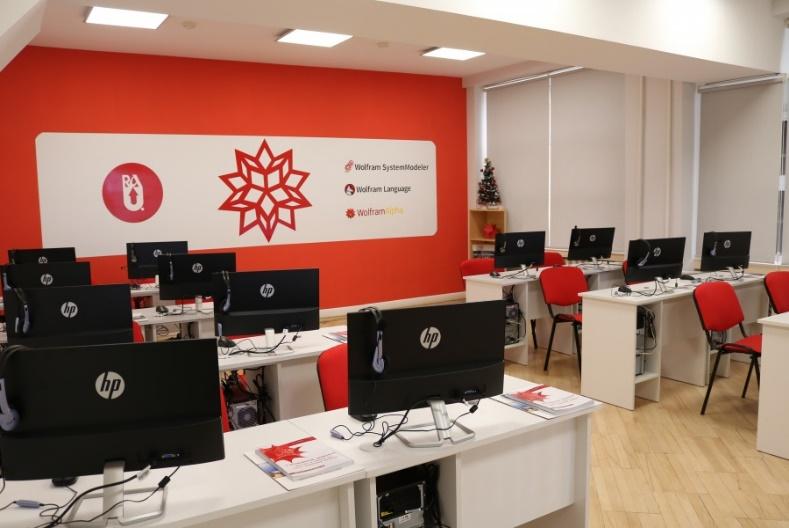
Wolfram Technologies are now available for use for the students, academic and research staff of Russian-Armenian University, who have the opportunity to move forward with their studies and research at the university-based Wolfram Laboratory.
Alla Gevorkyan
Latest News
-
08 April , 2026
-
17 March , 2026
-
10 March , 2026