



- 03 Jul
- 2025
RAU Russianists Acted as Co-Organizers and Participants of the International Seminar The Russian Language in the Context of Bilingualism: Linguistic and Methodological Aspects
Colleagues from RAU and SPbPU discussed current scientific issues related to the linguistic and methodological aspects of the functioning of the Russian language in conditions of bilingualism, with a focus on working with artistic bilingual texts and the cultural adaptation of a bilingual child.
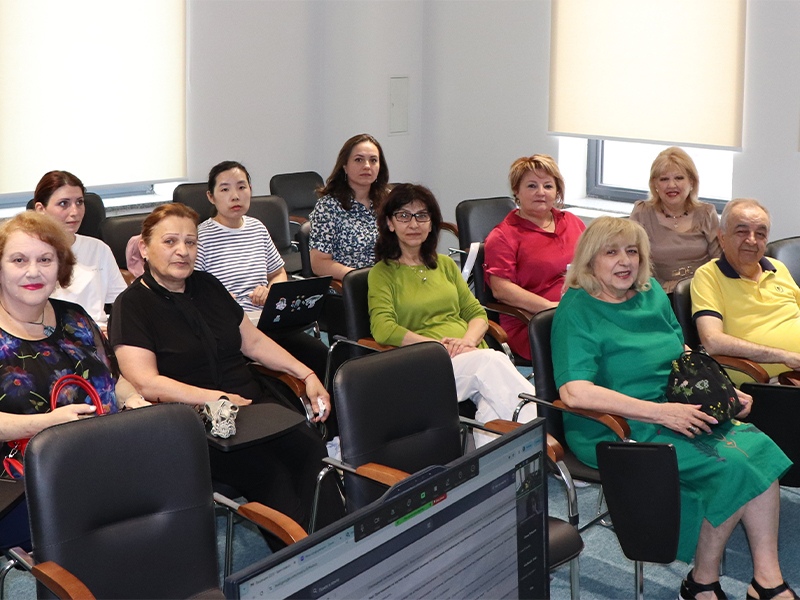
The International Interactive Scientific and Methodological Workshop “The Russian Language in the Context of Bilingualism” Linguistic and Methodological Aspects took place on June 23.The event was organized by the Center of Russian Studies of the Russian-Armenian (Slavonic) University together with the Department of Russian Language and Professional Communication of the Institute of Philology and Intercultural Communication of RAU, and the Higher School of Linguistics and Pedagogy of the Humanities Institute of Peter the Great St. Petersburg Polytechnic University.
During the workshop, colleagues discussed current scientific issues related to the linguistic and methodological aspects of the functioning of the Russian language in conditions of bilingualism, with a focus on working with artistic bilingual texts and the cultural adaptation of a bilingual child.
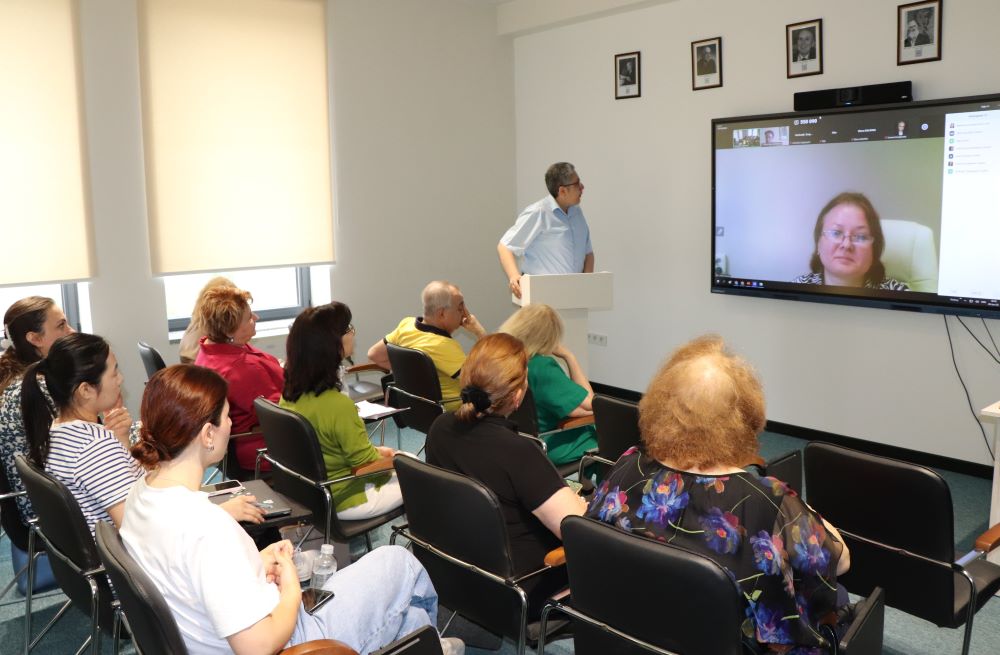 Karen Hakobyan, PhD in Philology, Professor, Head of the Department of Russian Language and Professional Communication, and Director of the Center for Russian Studies at RAU, presented the report On the Dynamics of the Russian Language in Armenia. His study was devoted to the analysis of the sociolinguistic situation of the Russian language in Armenia in a historical retrospective and contemporary context. The author examined the stages of change in its status, from the period of active functioning during Soviet times to the reduction of usage areas in the 1990s and the gradual restoration of positions in the 21st century. Special attention was paid to grammatical, phonetic, and lexical features of Russian speech among Armenians, as well as mutual linguistic influence.
Inna Sarkisyan, Doctor of Pedagogical Sciences, Professor at the Department of Russian Language and Professional Communication, spoke about bilingual programs for preschoolers and the concept of translanguaging, which involves the conscious use of all of the child’s language resources in the educational process. A key point of her report was the active implementation by preschool programs of elements of Content and Language Integrated Learning (CLIL) adapted to children’s age features. Thus, the role of family bilingual education and the interaction of the kindergarten with parents as active participants in language socialization increases.
Violetta Grigoryan, PhD in Philosophy, Associate Professor at the Department of Russian Language and Professional Communication, presented a report titled Collective Learning Methods at the Faculty of Informatics as Tools for Developing Bilingual Competence in Russian Language Learning. Special attention was paid to the use of group work with professional texts, translations, glossaries, and role game assignments aimed at overcoming interference and developing confidence in using Russian in a professional environment.
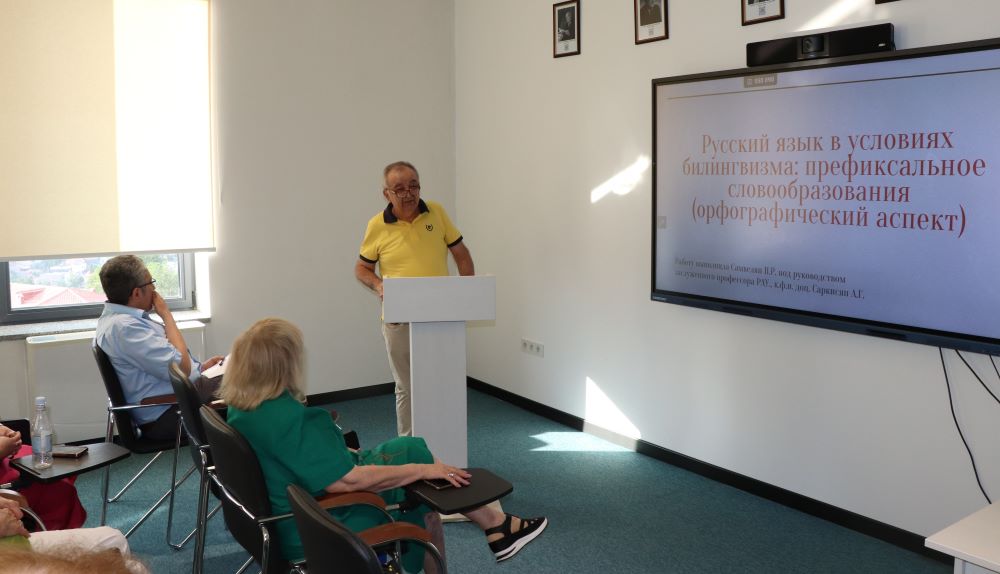 At the workshop, Arshak Sarkisyan, PhD in Philology, Associate Professor, Honorary Professor, and Associate Professor of the Department of Russian Language and Professional Communication at RAU, also presented a report together with Nelly Samvelyan, a student in Philology. The report analyzed 74 etymologically Russian prefixes (morphemes) presented in the Dictionary of Morphemes of the Russian Language (Kuznetsova A., Efremova T..Moscow, 1986), as well as affixoids such as arche-, mega-, nano-, and others, recorded by Z.Atsagortsian and S. Aslanyan in the Russian-Armenian Dictionary of International Terminology Elements (Yerevan, 1989). The presenter emphasized that prefixal word formation is an important tool in teaching Russian as a foreign language, as it not only helps expand learners’ vocabulary but also promotes a better understanding of the structure of the Russian language.
Equally relevant topics were presented by colleagues from Peter the Great St. Petersburg Polytechnic University: Tatyana Bekezina, Senior Methodologist, teacher at the Educational and Publishing Center Zlatoust, gave a report titled Interactive Textbook in the Russian Language School System (on the Example of the UMC ‘Polyot’); Alexandra Burtseva, PhD in Pedagogy,, Associate Professor, Associate Professor of the Higher School of Linguistics and Pedagogy, together with linguistics students, presented the report Regional Approach as a Means of Forming Cultural Competence of Foreign Language Learners. A project of a Reading Guide for Schools with a Multicultural Student Body; Sofya Krasnoshchekova, PhD in Philology, Research Fellow at the Department of Grammar Theory, Institute of Linguistics of the Russian Academy of Sciences, Associate Professor of the Higher School of Linguistics and Pedagogy at SPbPU, and Yelena Galkina, Research Fellow at the Department of Sensory Systems Physiology, Laboratory of Speech Psychophysiology, I.Pavlov Institute of Physiology of the Russian Academy of Sciences, presented the topic Features of Expressing Evidentiality in Russian-Language Media of the Kyrgyz Republic; Elizaveta Mukhamedshina, student majoring in Linguistics at SPbPU, together with Sofya Krasnoshchekova, PhD in Philology, Research Fellow at the Department of Grammar Theory, Institute of Linguistics of the Russian Academy of Sciences, Associate Professor of the Higher School of Linguistics and Pedagogy at SPbPU, presented the report Specifics of Language Competence Formation of Bilingual Children in the Context of Russian-Tatar Bilingualism.
The workshop was held in a hybrid format. It aroused genuine interest among colleagues and active discussion. Both sides expressed hope for the continuation of cooperation in the format of such international interactive scientific and methodological workshops and academic conferences.
Translated by Lyudmila Manucharyan
Latest News
-
23 October , 2026
-
23 October , 2026
-
22 October , 2026